Business
CEOs regain some confidence—but still keep a cautious hand on the wheel amid tariffs


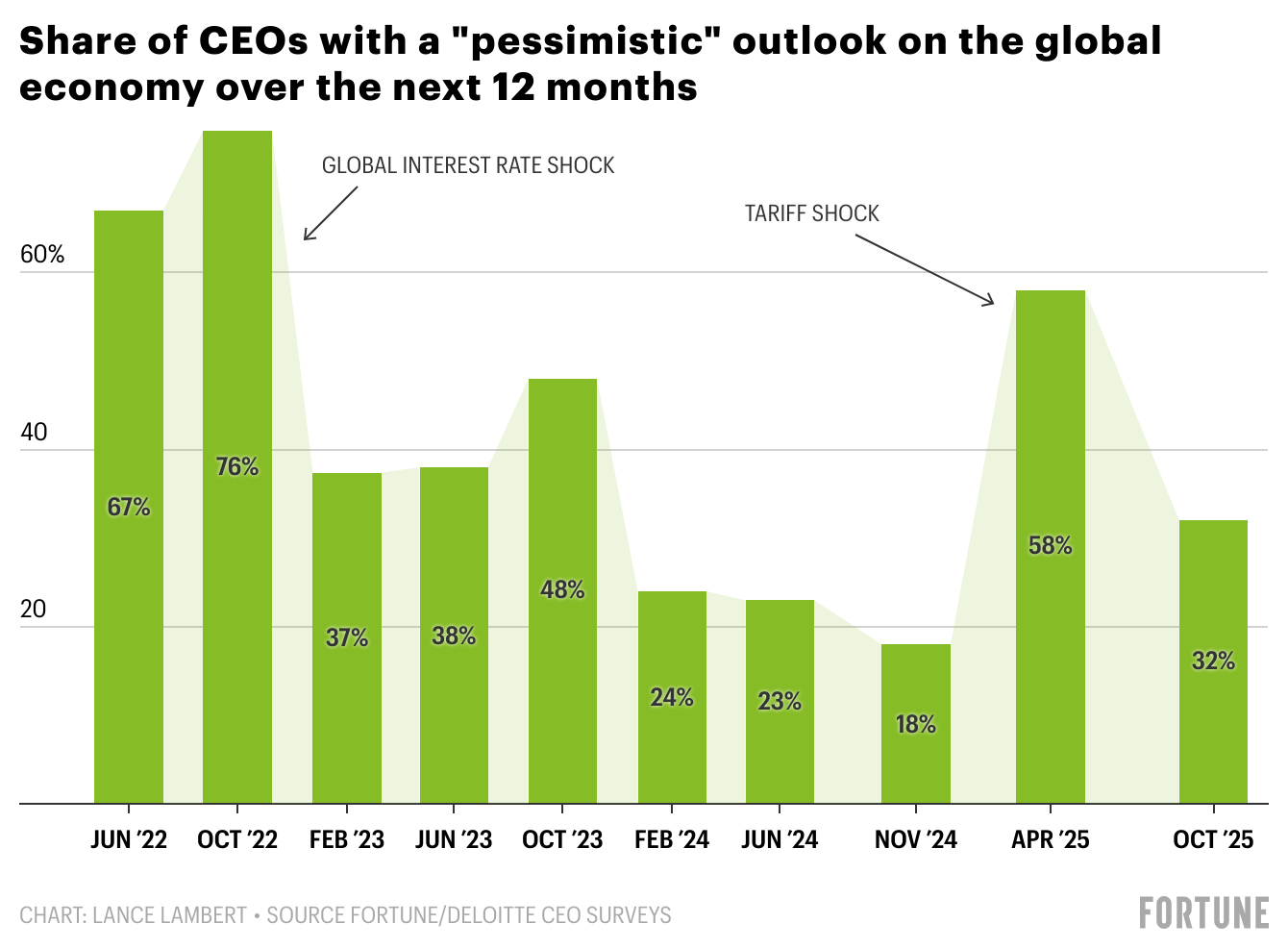
Six months ago, CEOs of the world’s largest companies were preparing for turbulence. In an April survey by Fortune and Deloitte, 58% of global chief executives described their 12‑month economic outlook as pessimistic—half were simply cautious, while 8% were very pessimistic. Their gloom stemmed from fears over sweeping tariffs and tightening global financial conditions. Today, however, that sentiment has shifted dramatically.
In the latest October survey, only 32% of CEOs now describe themselves as pessimistic about the global economy over the next year. Most say their concerns have eased, noting that tariffs have not disrupted global trade as feared.
While few CEOs are celebrating just yet, the overall mood has improved. Their focus has shifted to managing a still-volatile but increasingly stable global landscape, where AI-driven innovation is taking center stage.
The numbers to know
32% … of CEOs have a “pessimistic” (30%) or “very pessimistic” (2%) outlook for the global economy over the next 12 months.
26 … the percentage-point decline in pessimism since CEOs were last asked the same question in April 2025—at the height of the financial markets’ so-called “tariff tantrum.”
21% … of CEOs have a “pessimistic” (18%) or “very pessimistic” (3%) outlook for their industry performance over the next 12 months.
2% … of CEOs have a “pessimistic” (2%) or “very pessimistic” (0%) outlook for their company performance over the next 12 months.
37% … of CEOs say they think newly imposed tariffs will have a negative impact on their business. Another 51% say the impact will be neutral—meaning tariffs will bring a roughly equal mix of benefits and risks—while 10% say the tariffs will have a positive impact on their business.
80% … of CEOs say they are likely (38%) or very likely (42%) to implement cost-cutting measures over the next 12 months to offset higher costs related to current economic and trade policy uncertainties.

60% … of CEOs say AI will have a significant (45%) or transformational (15%) impact on their core processes over the next one to three years.
The big picture
After months of volatility and tariff worries, CEOs are starting to breathe easier. The Fortune and Deloitte survey finds leaders far less pessimistic about the global economy than they were in April. Many are now channeling energy toward cost discipline and AI-driven innovation rather than crisis management. It’s a shift from panic to pragmatism in the C-suite.
A few deeper takeaways…
CEOs are less bearish on the global economy than they were this spring
Earlier this year, CEO sentiment took a sharp turn south amid what many dubbed the “tariff tantrum.” As trade tensions flared and questions mounted about how new import duties might ripple through global supply chains, 58% of CEOs told Fortune in April that they were pessimistic about the world economy’s outlook over the next 12 months.
Six months later, that mood has eased. In the October survey, just 32% of CEOs described their outlook as pessimistic—a notable drop, though still above the lows seen in late 2024, when only 18% felt bearish. The shift suggests that while global growth remains uneven and risks persist, executives are adapting to the policy landscape and see less chance of a near-term downturn.
The rebound in confidence comes as inflation pressures have remained in check and the Federal Reserve has resumed cutting short-term rates. Still, optimism is far from universal. Several respondents said ongoing geopolitical tensions, supply chain realignments, and policy uncertainty continue to cloud their long-term planning. In short, the panic of spring has given way to a more measured realism—CEOs aren’t panicked or exuberant, but they remain a bit cautious.
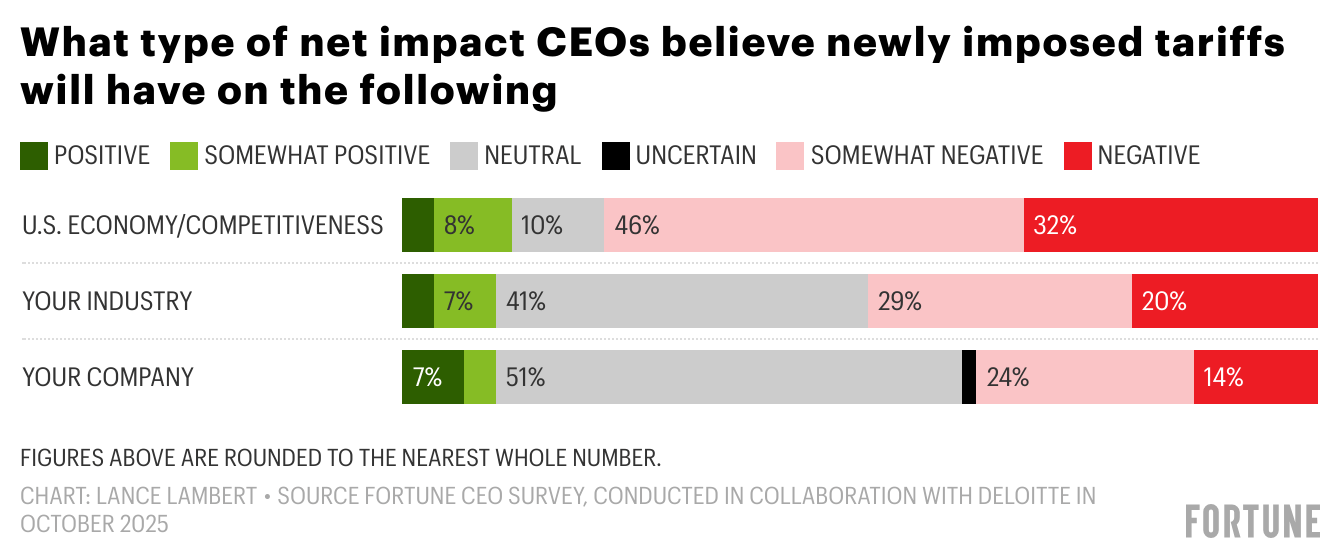
CEOs see tariffs as a drag on the U.S. economy—but less so on their own companies
Most CEOs think newly imposed tariffs will hurt the broader economy, even if their own firms can adapt. In Fortune’s October 2025 survey, 78% said tariffs will have a negative or somewhat negative impact on the U.S. economy. Yet when asked about their own company, more than half (51%) said the impact will be neutral, and only around one-third (38%) expect a negative or somewhat negative impact on their own company.
That disconnect suggests CEOs may be either overestimating the drag on the macroeconomy—or underestimating how those same pressures could eventually reach their bottom line. In short, CEOs see tariffs as bad for business—just not necessarily for their business.
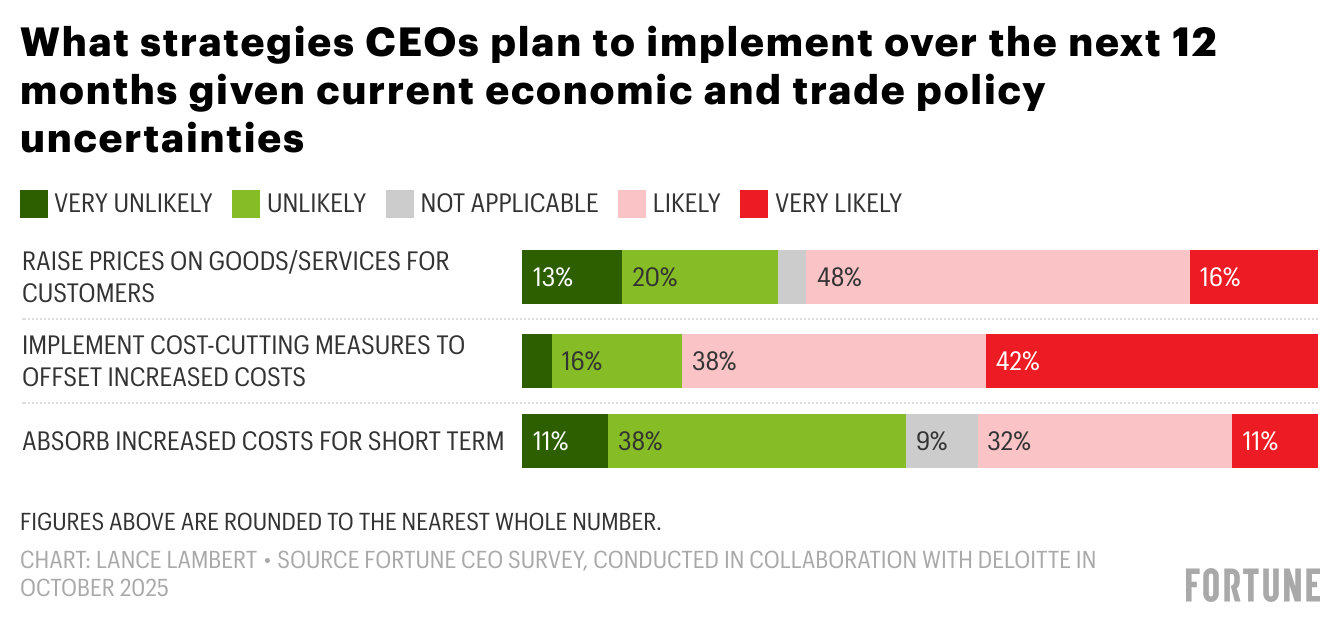
CEOs plan to cut costs before passing them to customers
With trade and economic uncertainty still lingering, most CEOs say their first move won’t be to raise prices—it’ll be to rein in expenses. According to Fortune’s October 2025 CEO survey, a combined 80% of respondents said they are likely or very likely to implement cost-cutting measures over the next 12 months to offset rising trade and policy-related costs.
By comparison, about 64% said they plan to raise prices on goods or services, while only 43% expect to absorb those higher costs, even temporarily. The data suggest CEOs are preparing for a period of tighter margins and unpredictable input costs, but are still wary of testing customers’ tolerance for price hikes too quickly.
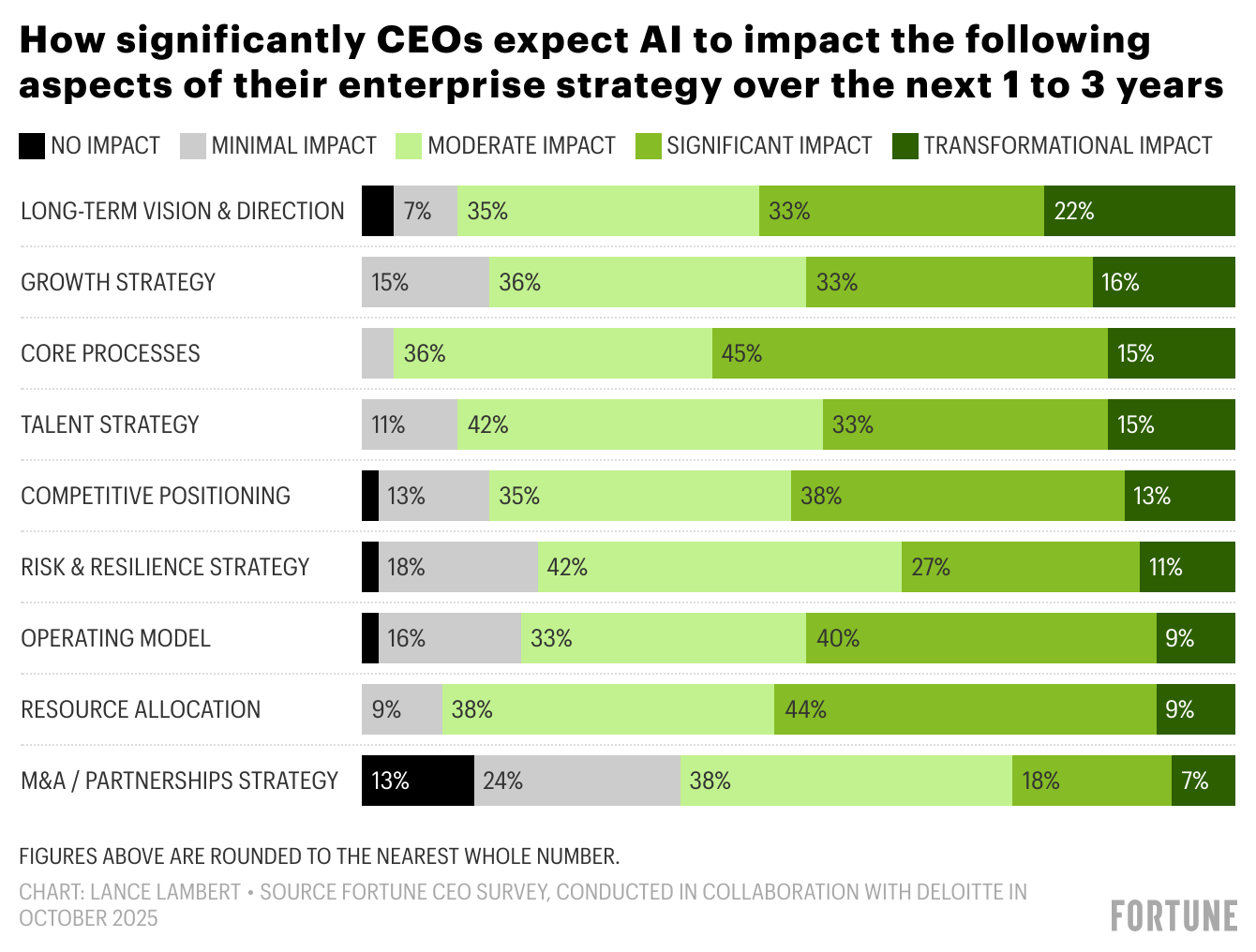
CEOs say AI is already reshaping their core operations
CEOs were most likely to cite core processes and resource allocation as areas seeing the deepest transformation. Around 60% of respondents said AI will have a significant or transformational effect on their core processes over the next one to three years.
AI’s influence is also extending into long-term vision, growth strategy, and competitive positioning, where roughly half of CEOs reported at least a moderate level of impact.
Methodology
Fortune surveyed CEOs in collaboration with Deloitte between Oct. 3–16. A total of 69 responded to the survey, which was sent to the Fortune CEO Community. That includes chief executives from Fortune 500 and Global 500 companies as well as those attending Fortune conferences.