Business
Powell just gave his strongest hint yet that rate cuts are coming, and investors are jubilant: ‘Stage is set for parabolic Q4’

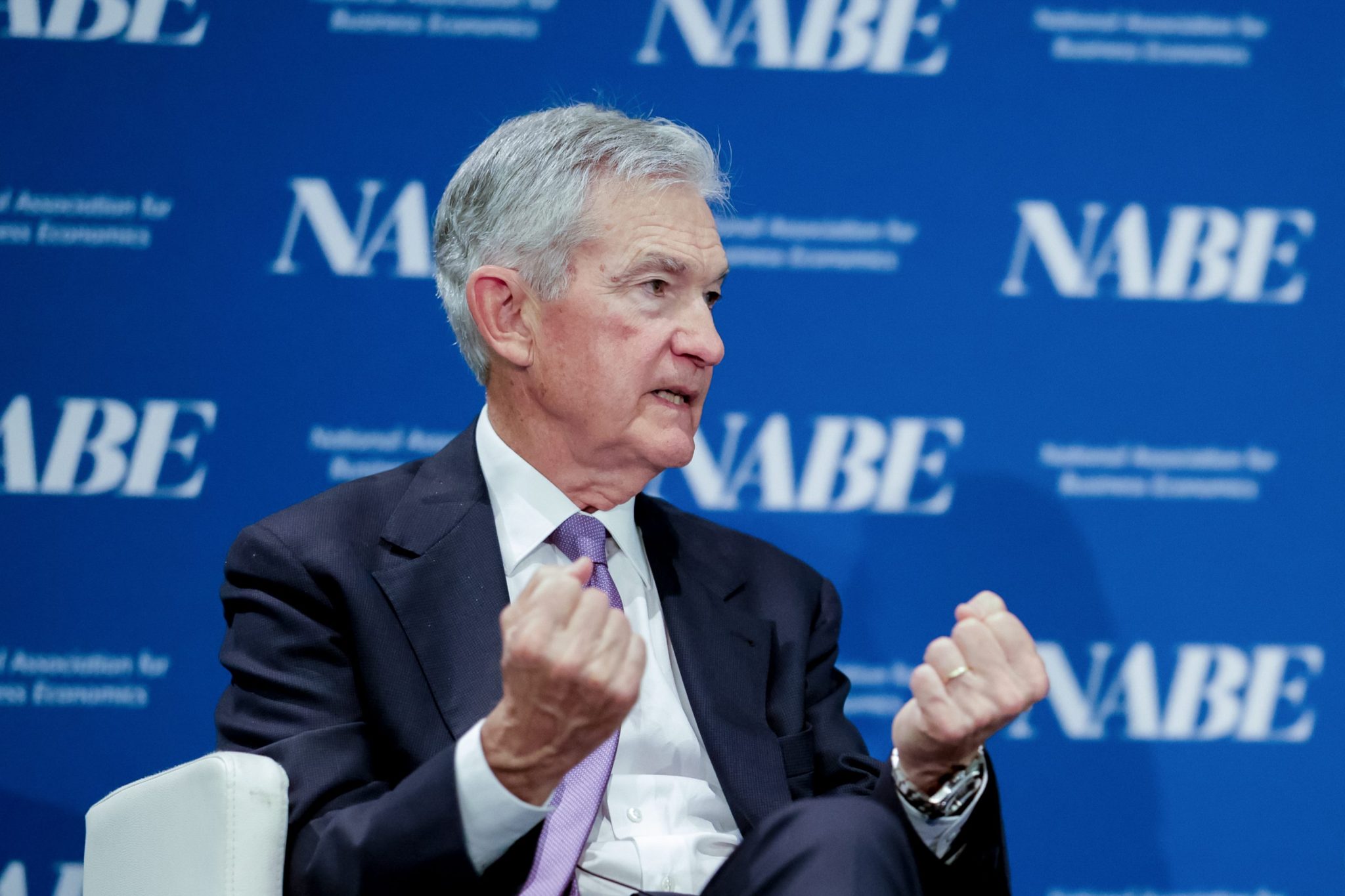
Federal Reserve Chair Jerome Powell is not known for giving decisive hints. Still, on Tuesday he did something rare: he openly acknowledged the rising “downside risks to unemployment” in a clearly dovish signal that the central bank is preparing to ease monetary policy.
Powell’s speech, delivered at an event for the National Association for Business Economics (NABE), was nominally about the Fed’s balance sheet. However, it concluded with a carefully placed shift in tone: the labor market is weakening faster than previously thought, inflation is no longer the sole threat, and policy may finally need to “take another step toward a more neutral stance.”
On Wall Street, there was little debate about what that meant—investors online rejoiced that “Powell is Dovish!”
Another crypto page on X exclaimed that the stage is set “for a parabolic Q4.”
Powell’s comments caused a kick-up in the Dow Tuesday afternoon, climbing nearly 400 points after having fallen 600 throughout the day due to trade tensions.
“Powell signals end of balance sheet rolloff—QT—in September and affirms market expectations for more rate cuts in October and December,” economist Diane Swonk wrote on X shortly after the speech, meaning that the rate-cut cycle is approaching. Investors expect with near certainty that the Fed will cut rates by 25 bps during October’s meeting, according to the CME FedWatch tool.
The KPMG chief economist noted that, in “classic Powell humility,” he acknowledged the Federal Reserve had been slow to halt monetary expansion in 2021 after several rounds of post-pandemic stimulus fueled inflation.
A shift driven by labor market risk
Indeed, the Fed has spent more than two years fighting sticky inflation with the most aggressive tightening cycle since the 1980s. In a moment of rare institutional self-reflection, Powell conceded that the Fed kept its balance sheet expansion going too long during the pandemic.
“With the clarity of hindsight, we could have—and perhaps should have—stopped asset purchases sooner,” he said.
That acknowledgement shows Powell is keenly aware of the cost of acting too slowly—and may now be erring on the side of avoiding a recession rather than crushing the last 0.9 percentage points of inflation to get the inflation rate down to the Fed’s target of 2%.

Powell noted that the Fed’s preferred inflation measure—core PCE—is running at 2.9%, but said much of the recent bump in goods prices reflected tariffs as opposed to intrinsic inflationary pressure. That line was not accidental. It distances price pressures from monetary policy and gives the Fed cover to cut rates without appearing to surrender on inflation.
For a Fed Chair who prefers restraint, this was messaging with intent. The fight against inflation isn’t over, but the Fed just acknowledged a new reality: jobs now matter as much as prices, and policy has to catch up.
Jobs present more of a risk now
But Powell acknowledged Tuesday that the central bank’s dual mandate—stable prices and maximum employment—has suddenly started pulling in the other direction.
“In this less dynamic and somewhat softer labor market, the downside risks to employment appear to have risen,” Powell said.
Payroll growth has slowed sharply, participation has dipped, and both business and household surveys show declining confidence in job availability, he added. Those are prime economic conditions to set up policy easing.
Balance sheet runoff ending
Powell added another doveish signal: an end to the Fed’s balance-sheet runoff, or quantitative tightening (QT), as soon as September. The Fed has been shrinking its portfolio of Treasurys and mortgage-backed securities at a pace of up to $95 billion per month in an effort to drain excess liquidity from the financial system.
But Powell warned reserves are now “gradually tightening,” and he emphasized the need to avoid a repeat of the 2019 funding squeeze, when interbank lending markets buckled. To avoid a repeat, he told the market exactly what it wanted to hear: QT is almost over, and soon more liquidity will be injected into the market.
“We will set policy based on the evolution of the economic outlook and the balance of risks, rather than following a predetermined path,” Powell told investors.