Business
Top defense CEO on America’s ‘anachronistic’ aging infrastructure: ‘Our adversary can use their entire industrial base’

One of America’s top defense CEOs says the biggest threat to national security isn’t technology, adversaries, or resources—it’s the fact that much of U.S. defense strategy has become anachronistic.
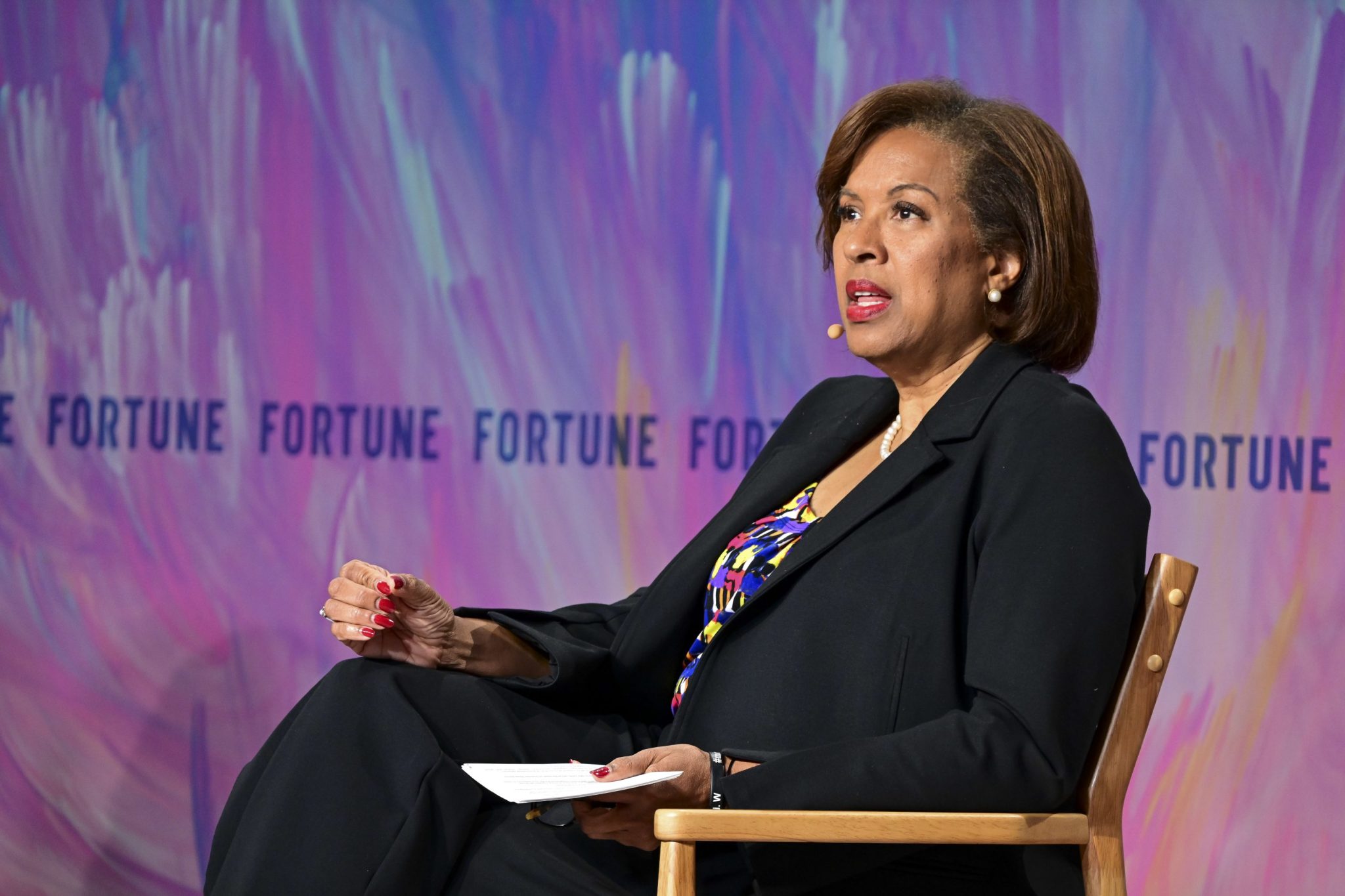
Speaking at Fortune‘s Most Powerful Women conference, SAIC Chief Executive Toni Townes-Whitley talked about how it may be “nerdy” and “geeky” but the world of warfare is increasingly less and less about conventional theaters of conflict. “Those areas where we had large seas or oceans between us and adversaries are no longer the boundary conditions that we have experienced,” she said, noting that the U.S. has adversaries that operate in “domains” beyond land, sea, and air, but also cyber and space. She had a message: the U.S. has more work to do to successfully defend against enemies like this.
For 57 years, Townes-Whitley said, SAIC has been at the “intersection” of commercial technology that is introduced to very complex mission environments. She said she sees that America’s enemies are operating in “multiple modes … I think one of the things that probably keeps us up at night in the national defense world is the fact that our adversary can use their entire industrial base.”
That is not quite the case in the U.S., she added, with an industrial base that has grown “anachronistic over time,” using a word that refers to something that belongs to another period than the present day. She added that what she considers the industrial base has “aged” into a situation of legacy capability. “We haven’t really seen the urgency of the signal yet that we need to in fact enlist all of our industrial base.” The nerdy, geeky answer, she continued, is that you can overcome America’s refusal to act like its adversary by connecting everything together with data.
Urgency and modernization
Modernization isn’t just about buying cutting-edge hardware, said the SAIC CEO, who became just the second Black female CEO in the Fortune 500 when she ascended to the top job in 2023. It’s about rethinking old policies, integrating new technologies, and merging the best of legacy systems with rapid digital innovation. The CEO pointed out that, despite impressive advancements in areas like digital engineering and AI for the battlefield, the underlying system struggles with urgency.
To illustrate the problem, the CEO described an exercise adopted from military leadership: “Would I do this in war?” They and their team wear bracelets inscribed with the acronym WTIW—“Would I do this in war?”—as a daily reminder to act with the speed and seriousness required in a true crisis. While the nation can mobilize impressively in moments of existential threat, sustaining that energy in peacetime—with adversaries lurking in ambiguous, unpredictable ways—is much harder.
The executive urged a cultural shift, advocating for a move away from terms and concepts rooted in the past. “I would argue that the words that we use are even anachronistic. Defense industrial base I would suggest is transitioning to a national security innovation ecosystem,” she said. This shift is about harnessing garage startups and tech giants alike, building plug-and-play systems that allow mission-driven innovation to flourish.
Interoperability, she added, is often “the least sexy word right now in national security, but the most important.” As coalition warfare becomes the norm, integrating data across multiple partners—each with distinct platforms and classification levels—can mean the difference between success and failure. She pointed to the Golden Dome Missile Defense System and NORAD operations as examples where simulated integration and digital twins demonstrate how collaboration can be effective when done correctly.
Real solutions, not just rhetoric
The CEO emphasized her company’s ongoing role in supporting the war fighter by merging legacy experience with bleeding-edge technology. A third of SAIC’s workforce is comprised of veterans, she noted, and two-thirds hold security clearances—a sign of their deep engagement with mission realities. But success demands more than credentials.
The country must develop an ecosystem that’s agile, tech-driven, and unified, with modernization efforts accelerated by digital engineering, scenario simulation, and an urgent focus on root-cause bottlenecks, many of which are policy-based rather than technological.

“The name, we can go left or right on the name. My whole focus is to support the warfighter in all that we do. Our language, our actions, our resources, our budget support the war fighter,” the CEO concluded.