News
Russia will raise taxes to pay for the Ukraine war

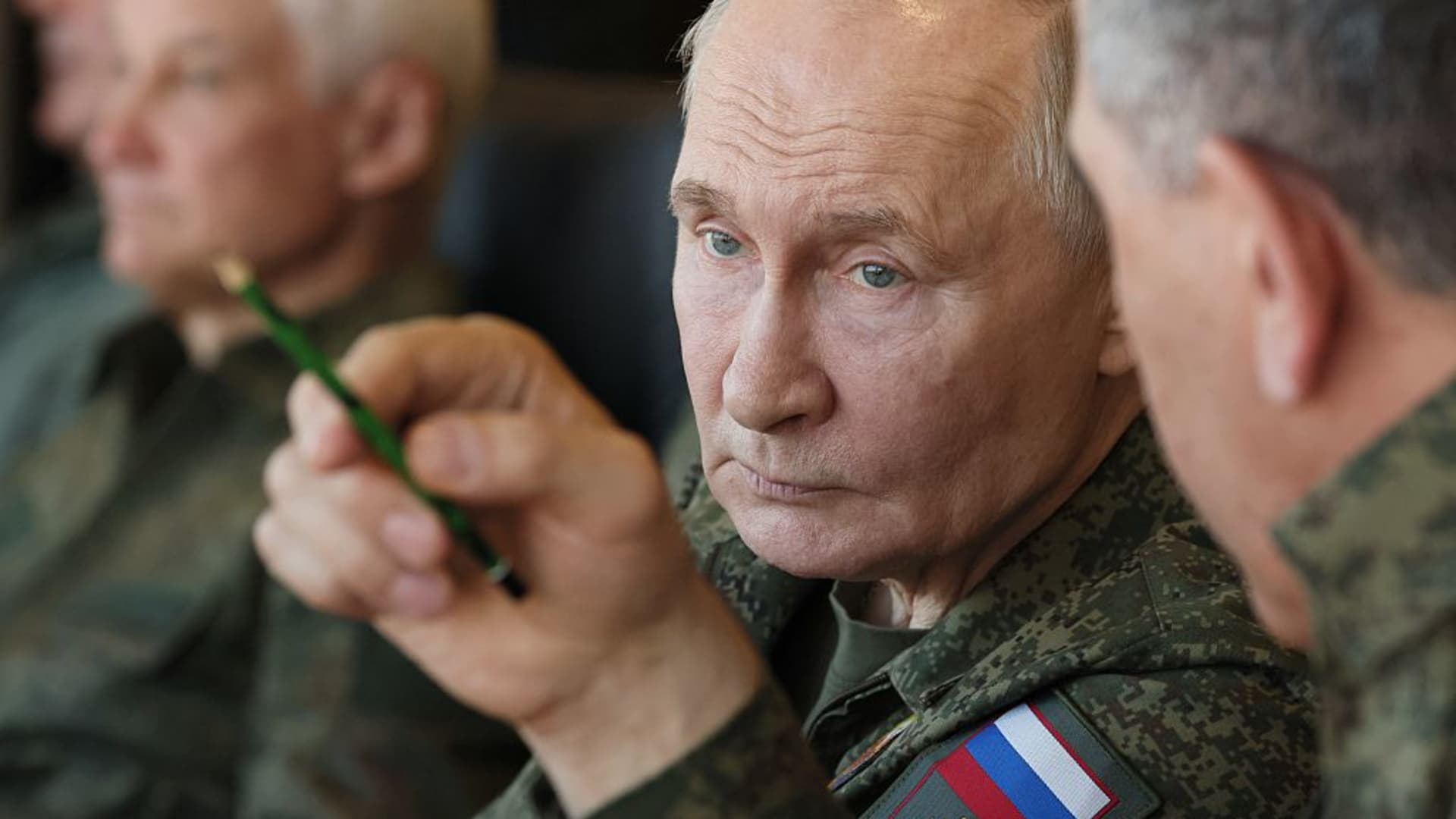
Russian President Vladimir Putin during a meeting on development of ‘new regions’, annexed from Ukraine, at the Kremlin, June 30, 2025, in Moscow, Russia.
Contributor | Getty Images
Russia is set to hike taxes on businesses and consumers as the government looks for ways to support military spending while its war-focused economy creaks at the seams.
The Kremlin’s commitment to the ongoing war with Ukraine came under renewed scrutiny Monday when the finance ministry released its 2026 draft budget. The spending plans show defense spending next year would stay largely static, and would be funded with tax hikes amid increasingly dour growth forecasts.
Presenting the budget this week, Russia’s finance ministry said that in order “to finance defense and security” it was proposing a number of tax hikes that it said were an alternative to increased borrowing and a way reduce the budget deficit, which was forecast at 1.6% of GDP in 2026.
Most notably, ministry officials said they planned to increase VAT from 20% to 22%, while the threshold at which small businesses start to pay VAT will be lowered from 60 million rubles (around $738,000) to 10 million rubles (around $123,000). The ministry also proposed a new 5% gambling tax.
The proposed tax hikes come as economic growth is expected to stutter to 1.3% in 2026, the government said — a far cry from the 4.1% expansion recorded in 2024 and a sharp drop from the previous projections for 2.5% growth this year and 2.4% next year.
The preliminary budget — which needs to be approved by the Russian parliament, the State Duma — suggested that defense spending would fall slightly in 2026, to 13 trillion rubles ($157 billion), down from a post-soviet record of 13.5 trillion rubles (or $163 billion) this year, according to preliminary finance ministry figures obtained by Reuters last week.

Russian public on the hook
The Russian public is effectively being told to pay for the war against Ukraine, analysts said of the budget proposals, warning that the country was entering a low-growth era.
“As economic growth stalls and revenues decline, Moscow is no longer able to pump up the fiscal stimulus that fueled earlier wartime expansion, instead embracing austerity measures that threaten to further strangle the civilian economy,” Alexander Kolyander, senior fellow at the Center for European Policy Analysis, noted in analysis this week.
“Moscow’s financial strategy for the fifth year of war is unmistakable … the Kremlin will attempt to muddle through without major expenditure increases, instead passing the war’s costs to the whole of society,” he said.
A Moscow shopping mall pictured earlier this year.
Anadolu | Anadolu | Getty Images
The new budget confirms that “the Russian public is paying for the war,” Alexandra Prokopenko, fellow at the Carnegie Russia Eurasia Center, said in analysis Wednesday.
Noting that the 2026 budget looks “more and more like a compromise between the war camp and economists,” she said “footing the bill will be the Russian people, who face further tax hikes.”
She cautioned that the nominal reduction in defense spending in 2026 “is certainly not a sign that the Kremlin plans to end its war against Ukraine.”
“Budget spending in the national defense category may be declining from 13.4 trillion rubles this year to 12.6 trillion rubles in 2026 (a decrease of 4.2%), but spending in an adjacent category — national security and law enforcement— is increasing from 3.46 trillion to 3.91 trillion rubles: a 13% increase,” Prokopenko noted.
Inflation eyed
Russia’s war against Ukraine, which began in 2022, prompted a sea-change in the country’s economy, with rampant government spending on defense and the military-industrial complex fueling both economic growth but also inflation, which was further exacerbated by sanctions, labor shortages and higher wage demand, and supply constraints.
Price rises, particularly of basic goods like butter and meat, have been hard on Russian consumers. The country’s central bank has looked to tame inflation with high interest rates, increasing borrowing costs for businesses and acting, paradoxically, as another brake on economic growth. The latest data showed inflation stood at 8.1% in August, while the central bank’s benchmark interest rate was at 17%.
A customer with a cart chooses cheese at the Okey supermarket in St. Petersburg.
Sopa Images | Lightrocket | Getty Images
Russia’s Finance Minister Anton Siluanov was grilled by state media outfit TASS this week on the rationale behind tax rises on consumers and entrepreneurs. He told the agency that they were preferable to increased borrowing, which would fuel inflation.
“An uncontrolled increase in public debt would lead to accelerated inflation and, consequently, an increase in the key rate. Conversely, the decision to balance the budget through tax increases gives the Central Bank room to ease monetary policy. The key rate is crucial for investment growth and economic growth,” he told TASS.
Russian Finance Minister Anton Siluanov (seen here with Russian President Vladimir Putin in 2019) reportedly told Russian newspaper Vedomosti that Moscow will continue to service external debts in rubles, but foreign Eurobond holders will need to open ruble and hard currency accounts with Russian banks in order to receive payments.
Mikhail Svetlov | Getty Images News | Getty Images
Asked if the defense budget would increase, Siluanov suggested that national security would become more of a focus for the government with defense and security expenditures set to take into account “additional tasks and challenges.”
These, he suggested, included “other functional areas related less to military defense than to ensuring the security of the country and its citizens as a whole.”
This included the development of counter-drone systems, the protection of critical infrastructure and border areas, enhanced transport security, and cybersecurity, he said. “Overall spending in 2026 remains at a level comparable to 2025, but is higher than the 2024 level,” he noted.