Business
Rattled Wall Street on alert after trillion-dollar risk runup

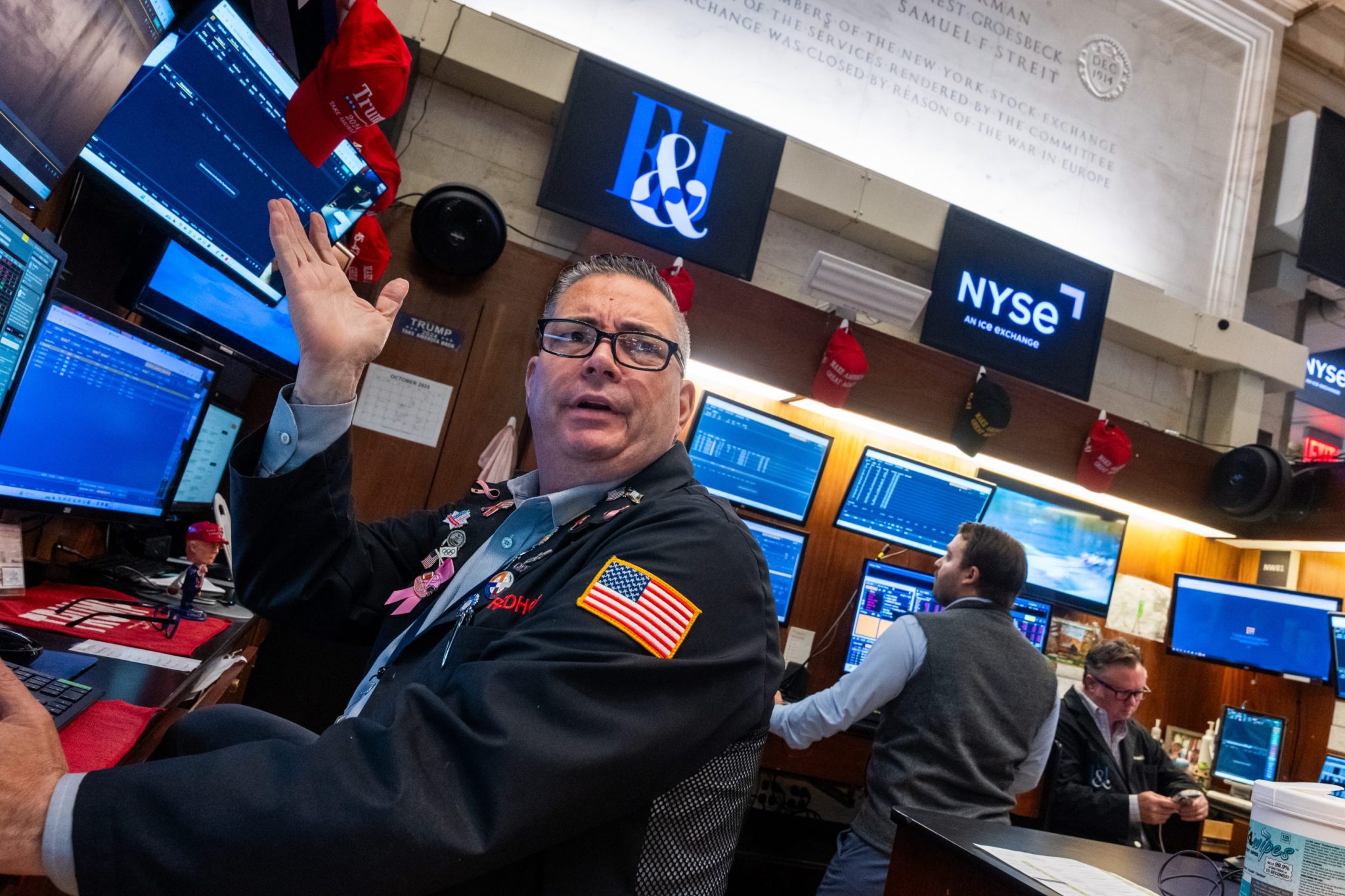
After two months of market bliss, Wall Street is stirring from its slumber.
First the collapse of First Brands Group and Tricolor Holdings revived long-dormant fears about hidden credit losses. Then, fraud-linked writedowns at Zions Bancorp and Western Alliance — erasing more than $100 billion in US bank share value in a day — stoked concern that the lending stress is more pervasive.
Until recently, investors have shrugged off everything from the government shutdown to stretched valuations, buoyed by the AI boom and resilient consumer data. That left positioning looking aggressive. According to Societe Generale, allocations to risky assets like equities and credit climbed to 67% of tracked portfolios at the end of August — near peak levels.
Stocks still ended the week with a tidy gain, extending a bull market that’s already added $28 trillion to its value, after President Donald Trump retreated from last Friday’s tariff threats. But six days of volatility across assets shows a deeper anxiety taking hold: credit fragility. More than $3 billion flowed out of high-yield bond funds in the week through Wednesday, according to EPFR Global. Risk-on momentum trades like crypto, once untouchable, are also losing steam.
In quant portfolios, strategies that cordon off credit risk are back in fashion. A pair trade betting against higher leveraged firms — and backing their low-debt peers — is once again delivering strong gains, echoing patterns seen before the dot-com peak, according to Evercore ISI.
None of these moves point to a lasting bearish turn. But the tone has shifted. Taken together — lax credit standards resurfacing, leveraged firms falling out of favor, speculative flows unmoored from fundamentals — the echoes with past turning points are fanning a spirit of discipline among a cohort of big money managers.
John Roe, head of multi-asset funds at Legal & General, which manages $1.5 trillion, said his team moved to reduce risk, citing a growing mismatch between investor positioning and underlying fundamentals.
“In recent weeks we saw it as an under-appreciated risk against the backdrop of elevated, though not extreme, investor sentiment,” Roe said. “This was a key part of a decision to reduce risk taking and go short equities on Wednesday.”
The firm was already underweight credit, citing tight spreads and limited upside. And while the collapses of Tricolor and First Brands were widely seen as idiosyncratic, Roe’s team viewed them as potential warning signs of broader strain, particularly among lower-income borrowers.
Others had a similar thought.

“I believe we’re entering a classic credit downcycle,” said Ulrich Urbahn, head of multi-asset strategy and research at Berenberg. “It’s not catastrophic, but there is a growing risk that it will mark a turning point in the broader environment.”
In the past two weeks, Urbahn said he has added equity hedges, trimming his equity exposure by roughly 10 percentage points and turning underweight. He sold S&P 500 call options to help fund protective wagers, and even scaled back positions in gold and silver — trades that had become increasingly crowded.
“After the year-to-date performance,” he said, “there is a lot of motivation to protect strong gains.”
Despite the credit concerns, the S&P 500 ended the week 1.7% higher even as the S&P Regional Banks Select Industry Index fell nearly 2% in its fourth consecutive week of losses. Spreads on high-yield corporate bonds, though still historically tight, have widened 0.25 percentage point this month to 2.92 percentage points. The VVIX — or the vol of vol, which tracks the speed of shifts in investor sentiment — hit its highest level since April. A measure for tail-risk insurance demand also jumped to the highest level in six months.
The push into risky assets hasn’t been driven by confidence alone. For active managers, 2025 is shaping up as one of the worst years ever recorded, with the proportion of long-only actively managed funds beating benchmarks falling to 22% in 2025, according to data from Jefferies Financial Group Inc. That pressure has intensified the chase for what’s working — even as fundamentals deteriorate.
At the far edge of the risk spectrum, crypto failed to bounce after last Friday’s $150 billion wipeout. Unlike past crashes, there was no retail rush to buy the dip — just silence. That restraint, despite falling rates and looser liquidity, hints at a shift: less mania, more risk control. And the cooling could spread beyond tokens.
Not everyone sees the recent tremors as a turning point.
Garrett Melson, a portfolio strategist at Natixis Investment Managers Solutions, said the selloff tied to Zions and Western Alliance looked more like an overreaction to isolated stress than a sign of deeper credit strain.
“It probably says more about positioning and sentiment than anything else,” he said. While spreads are tight, Melson still sees strong fundamentals and solid carry in credit. His team recently moved from a slight underweight in equities back to neutral. “And so neutral seems to be the good way to position,” he said, “until you have a better opportunity to really lean more aggressively into an overweight.”