Business
Economist awarded Nobel prize before his morning coffee or walking his dog: ‘I had no clue that anything like this was going to happen’


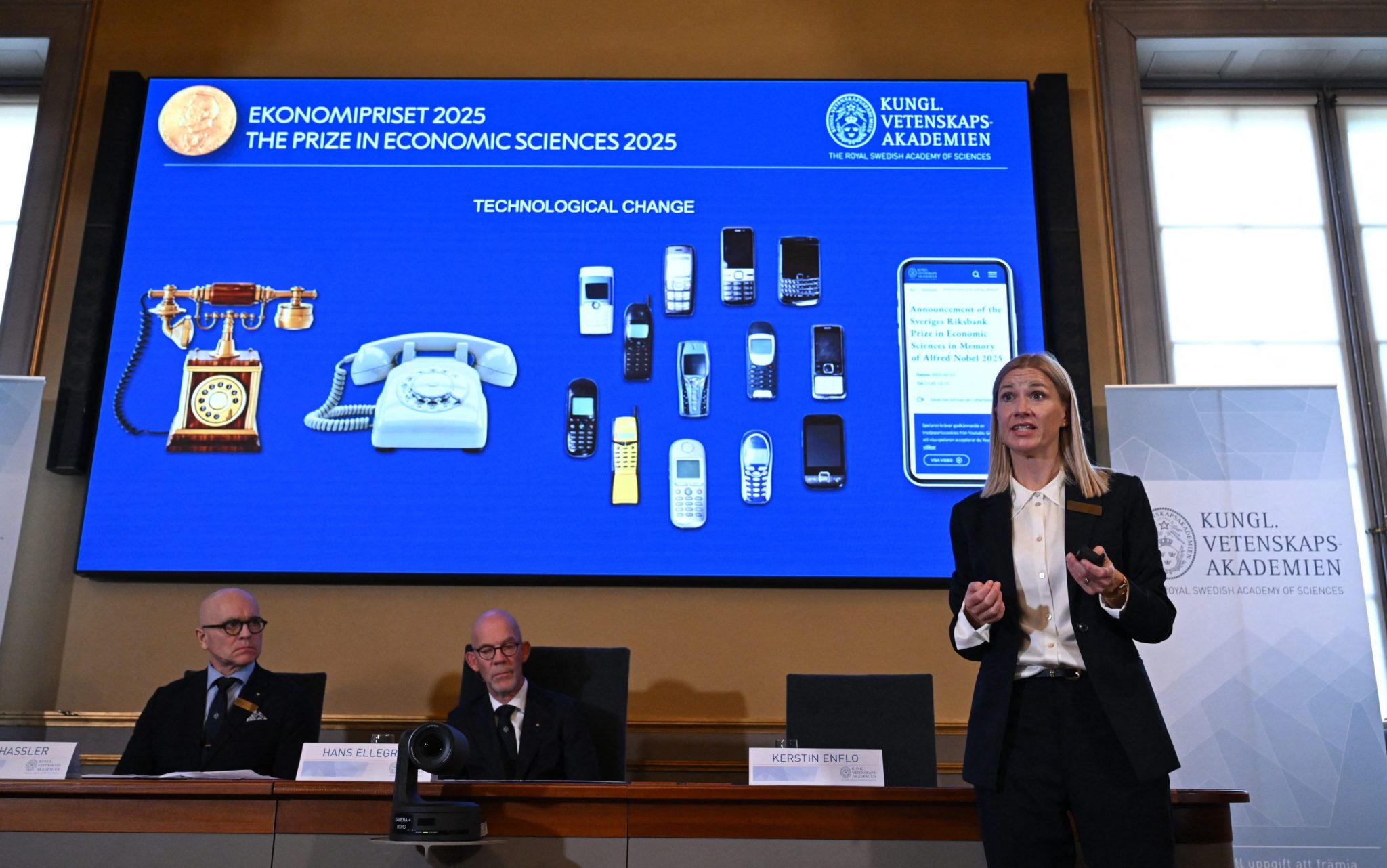
Three researchers who probed the process of business innovation won the Nobel memorial prize in economics Monday for explaining how new products and inventions promote economic growth and human welfare, even as they leave older companies in the dust.
Their work was credited with helping economists better understand how ideas and technology succeed by disrupting established ways — a process as old as steam locomotives replacing horse-drawn wagons and as contemporary as e-commerce shuttering shopping malls.
Dutch-born Joel Mokyr, 79, is at Northwestern University; Philippe Aghion, 69, works at the Collège de France and the London School of Economics; and Canadian-born Peter Howitt, 79, is at Brown University.
A clearer understanding of ‘creative destruction’
The winners were credited with better explaining and quantifying “creative destruction,” a key concept in economics that refers to the process in which beneficial new innovations replace — and thus destroy — older technologies and businesses.
The concept is usually associated with economist Joseph Schumpeter, who outlined it in his 1942 book “Capitalism, Socialism and Democracy.” Schumpeter called the concept “the essential fact about capitalism.”
The Nobel committee said Mokyr “demonstrated that if innovations are to succeed one another in a self-generating process, we not only need to know that something works, but we also need to have scientific explanations for why.”
Aghion and Howitt studied the mechanisms behind sustained growth, including in a 1992 article that offered a complex mathematical model for creative destruction that added new aspects not included in earlier models.
Examples of creative destruction include e-commerce disrupting retail, streaming services replacing videocassette and DVD rentals and internet advertising undermining newspaper advertising.
Process is key to economic growth and human welfare
“The laureates’ work shows that economic growth cannot be taken for granted. We must uphold the mechanisms that underlie creative destruction, so that we do not fall back into stagnation,” said John Hassler, chair of the committee for the prize in economic sciences.
Mokyr has long been known as an optimist about recent technological innovation. About a decade ago, many economists took a more pessimistic view, arguing that inventions such as smartphones or even the internet had less of an economic impact than previous developments such as the airplane or the car.

Mokyr responded that because many new services were either cheap or free, their impact wasn’t evident in economic data, but they still provided enormous benefits.
In an interview with The Associated Press in 2015, he cited the music streaming service Spotify as an example of an “absolutely astonishing” innovation that economists had difficulty measuring. Mokyr noted he once owned more than 1,000 CDs and, before that, “I spent a large amount of my graduate student budget on vinyl records.” But now he could access a huge music library for a small monthly fee.
Mokyr acknowledged that the disruption from new inventions often caused at least short-term job loss or reduced earnings for workers, but like many economists, he argued that the innovations also created new, unexpected jobs that offered fresh opportunities.
Workers in the “newly industrializing part of the economy had legitimate concerns with regard to wages, standards of living, and inequality,” he wrote in a 2015 paper. Yet the new factories and machines created new jobs, at least for their descendants: “The children of the displaced handloom weavers not only had the option to work in machine-intensive cotton mills; they could also become trained engineers and telegraph operators,” he wrote.
The Nobel committee noted that for much of human history, economic stagnation, rather than growth, was the norm. Starting with the Industrial Revolution in the 18th century, however, European and later other economies began to grow steadily.
Mokyr acknowledged that the relationship between knowledge, technology and growth seemed “so self-evident” but noted that economists “actually rarely have dealt with it explicitly.”
Innovation — and how to foster it — is an urgent question in Europe, where a report by former European Central Bank head Mario Draghi argued that Europe faces a rising productivity gap with the U.S. in digital technology. Aghion said the challenge was for Europe not to fall behind the U.S. and China in innovation but to promote research and the venture capital financing to turn ideas into businesses.
“We have fantastic basic research … but we need to harness the full power of innovation,” he said.
An early morning surprise
Mokyr was still trying to get his morning coffee when he was reached by an AP reporter. He said he was shocked to win the prize.
“People always say this, but in this case I am being truthful — I had no clue that anything like this was going to happen,” he said.
His students had asked him about the possibility he would win the Nobel, he said. “I told them that I was more likely to be elected pope than to win the Nobel prize in economics — and I am Jewish, by the way.”
Mokyr will turn 80 next summer but said he has no plans to retire. “This is the type of job that I dreamed about my entire life,” he said.
He then hung up to go walk his dog.
What exactly did the three economists win?
One half of the 11 million Swedish kronor (nearly $1.2 million) prize goes to Mokyr, and the other half is shared by Aghion and Howitt. Winners also receive an 18-carat gold medal and a diploma.
The economics prize is formally known as the Bank of Sweden Prize in Economic Sciences in Memory of Alfred Nobel. The central bank established it in 1968 as a memorial to Nobel, the 19th-century Swedish businessman and chemist who invented dynamite and established the five Nobel Prizes.
Since then, it has been awarded 57 times to a total of 99 laureates. Only three of the winners have been women.
Nobel purists stress that the economics prize is technically not a Nobel Prize, but it is always presented together with the others on Dec. 10, the anniversary of Nobel’s death in 1896.
Nobel honors were announced last week in medicine, physics, chemistry, literature and peace.
___
McHugh reported from Frankfurt, Germany, and Rugaber from Washington and Corder from The Hague, Netherlands.