Business
There are 3 key reasons why remote work is actually bringing you down, according to top management experts


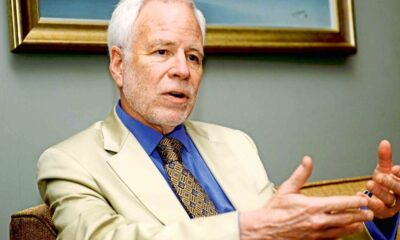
“It just seems kind of nutty,” Peter Cappelli tells Fortune, on a Zoom call, as he and his co-author, Ranya Nehmeh, discuss their new, aptly titled book, “In Praise of the Office.” The last five years have been quite a journey from fully remote work to an uneasy hybrid truce to a battle by many big companies to bring workers back five days a week, to wherever we are now. “People were starting to see this just as a kind of Marxist [thing], they were never saying that, but that’s the way they were thinking about it, right? Class battle, capital versus labor stuff, you know?”
Cappelli insists he and Nehmeh, both college professors and management scholars with expertise in human resources, were clear-eyed about what they’d find when they began researching their new book. Cappelli is a long-tenured management professor at the University of Pennsylvania’s Wharton School, and Nehmeh is an adjunct professor at Vienna’s University of Applied Sciences for Management & Communication. “We both work remote,” Cappelli acknowledged, but he also pointed out he’s racked up four decades of experience.
“I don’t need to be in the office … but I can also see how much worse the place is, because people like me are not in the office, and because we’re not in, the junior people aren’t there either, and so nobody’s there, right?”
Cappelli said it’s just obvious to him how much worse it is for his own organization. “Fine for me!” he said, “but bad for everybody else.”
Fears for the future
What he and Nehmeh found, they told Fortune, is that remote work has only become “increasingly problematic over time.” It’s understandable that it’s proved sticky, since it succeeded remarkably during the pandemic. “We expected nothing [out of it], and it was enormously better than that,” he added. Their book reads as a tacit endorsement behind the bold actions of some CEOs such as Amazon’s Andy Jassy, who has mandated five days back in the office for all employees, but it’s really about management principles and, Cappelli added, his fears over the future of the workplace: that workers will conclude they don’t need to learn from each other anymore.
Nehmeh said you can see the hazards of mismanaged hybrid work in the behavior of Gen Z, which she called “very transactional … I show up, I do my job, I get out. I don’t want to be part of anything else.” Not even the social aspect, work environment, organization, or culture, she added.
Cappelli agreed, saying what he saw out of so many students who were used to being hybrid and remote was stunning, particularly soon after the pandemic. “They just didn’t come to class,” he said, “and they were surprised that they were supposed to.”
When they did show up, they were not prepared, and didn’t think they were supposed to contribute beyond turning in assignments. His solution: He failed a bunch of people, and that got the message across.
Nehmeh agrees something has gone missing in the age of remote work, noting reports of some companies offering etiquette classes to Gen Z on how to act in meetings, dress for work, and talk to clients. These are all things that you used to learn when you joined an organization, she added.
Still, Cappelli and Nehmeh didn’t blame Gen Z for their lack of preparation, or the world of work that they emerged into. Both agreed their research indicated a failure higher up the chain. Nehmeh said she saw staff surveys showing that prior problems with poor communication, lack of recognition, unclear priorities and burnout “have only been magnified.” When organizations ignore survey feedback in a remote environment, she added, “the gap between what leaders think is happening and what employees are actually experiencing becomes even wider. The result is disengagement, frustration, and a sense that the organization isn’t listening.”

Cappelli was more blunt. At least in the U.S., he argued, the problems boil down to one simple thing: “Management’s just gotten worse.” They highlighted three main reasons that it’s time to call it a night for the remote workday.
1) Culture clash
A recurring theme for Cappelli and Nehmeh was the erosion of organizational culture and community. The authors described how, in a hybrid world, newer employees in particular struggle to learn by observation or build relationships—key aspects of professional growth that depended on physical proximity.
But that’s just the tip of the iceberg, or the top of the waterfall. They described a cascading effect downwards onto mid-level and senior-level employees, who become increasingly detached from their jobs as work gets defined down to something that happens on a screen, not in real life.
Nehmeh said new hires suffer in this hybrid environment, because they cannot really learn by example and they don’t get the guidance or support that facilitates professional growth. They both described the horror of the “ping” familiar to any remote worker.
Consider the entry-level worker who needs help, Nehmeh adds: “You have to schedule a call, you have to ping somebody, they may not respond back if they don’t know you … there’s so many issues there.”
2) Everything is a transaction
A less obvious outcome of the cultural erosion, Cappelli added, is that remote work leads people to think about their job more narrowly. Work has been boiled down to key performance indicators, or KPIs, blurring the line between the letter of the law and spirit of the law, so to speak. He said this started during the pandemic, when supervisors were told to hold people accountable, and with everyone working remotely, the easiest solution was to emphasize KPIs.
Cappelli conjured a world of strict KPIs and constant pings, but the problem is the people you’re pinging have their own KPIs, too. “If you want help from somebody, you have to ping them, and you ping, and, you know, they get the message, but it goes to the bottom of their stack.”
He said they conducted 38 separate focus groups, 760 people in all, and many responded that they would get to their “pings” after they finished their own work.
Cappelli said this might seem small but he thinks it’s a huge change that really affects performance management. The office involved social relationships, while the world of pings and KPIs is reducing everything to a transaction.
3) The productivity-sapping meetings problem
None of this should diminish the breakthrough of remote work in 2020, they argue, but that was a solution to an emergency, and cracks in the system are now more visible after several years.
The authors argued that Zoom meetings, which seem more efficient, actually make workers less productive while adding to the length of their average work day, meaning that productivity per hour is actually down. Cappelli said he thinks there are too many of these meetings, they go on for too long, and too many people tune out, turning off their cameras when they are likely doing other things.
Cappelli urged managers to rethink meetings that take up too much of people’s time, full of awkwardness that seems normal now but would have seemed bizarre five years ago. He said that more recently, he has heard of people skipping meetings and sending their AI agent to take notes in their stead. “They’re not even pretending to listen!”
Cappelli said that as meetings get bigger and less gets done, some people are even turning to post-meeting meetings to make sure they’re still on track. “It’s a mess. Those things could be fixed, right? But they’re not being fixed.”